Check the starting point
- Count edges incident to each vertex.
- Add positive route weights without repeating unintended edges.
Show the idea
A small weighted network
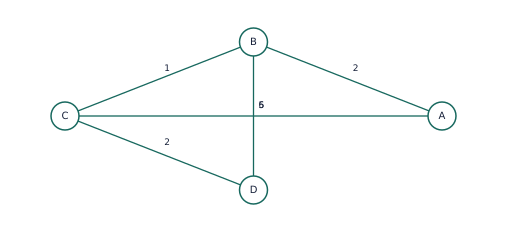
AB, BC and CD connect all four vertices with total weight 5. The route A–B–C–D also has length 5 in this example; the two optimisation goals differ in general.
Work through an example
A connected planar graph has 6 vertices and 8 edges. Find faces.
- For a connected planar graph, Euler's relation is V-E+F=2; F includes the unbounded outside face.
- Substitute V=6 and E=8: 6-8+F=2, so -2+F=2.
- Add 2 to both sides to obtain F=4. Three bounded faces plus the outside face would make four in total.
Answer: 4.
Teach in small steps
- Read the visual model together: AB, BC and CD connect all four vertices with total weight 5. The route A–B–C–D also has length 5 in this example; the two optimisation goals differ in general.
- Model this example aloud: An undirected graph has edges AB, BC, CA and AD. Give all degrees and check the handshaking lemma. Guide: Every edge contributes one degree at each endpoint. Result: A=3, B=2, C=2, D=1; degree sum 8=2×4.
- Let your learner choose the steps for a new situation: For undirected edges AB=3, AC=9, BC=2, BD=6 and CD=1, find a shortest A-to-D route. Ask which part of the model or rule carries over before checking the worked solution.
- After a short break, ask for an independent response: A tree has 15 edges. How many vertices does it have? Compare both the method and conclusion with the checkpoint answers, then revisit any misconception.
Ask and listen
- A connected planar graph has 8 vertices and 11 edges. Find its number of faces, including the outside face.
- The sequence A–B–C–A uses three different edges of a triangle. Is it a trail? Is it a path under the no-repeated-vertices definition?
Adapt the practice
More support
Start with this prerequisite: Count edges incident to each vertex. Keep the visual visible. For the first guided problem, focus on this step: Every edge contributes one degree at each endpoint.
More challenge
Try this application without looking at its answer: For the same network, give a minimum spanning tree and its total weight. Then explain why the answer fits the stated domain or context.
Look for understanding
- Your learner can complete this checkpoint and explain the method: A tree has 15 edges. How many vertices does it have?
- Your learner can justify or challenge this statement/question using the mathematical definitions: The sequence A–B–C–A uses three different edges of a triangle. Is it a trail? Is it a path under the no-repeated-vertices definition?
Choose the next step
If either checkpoint needs prompting, repeat the worked model with changed values and revisit this caution: A minimum spanning tree minimises total connecting cost; it does not generally provide every shortest route. When both are secure, use the linked Apply and extend resource and relevant VCE Key Knowledge/Key Skills activity.
Put the idea into practice
The matching topic collection includes learn-and-practise, application and checkpoint PDFs with worked answers. Download the free preview to see representative pages.
Explore this topic’s worksheets