Counting and ordering to 20
Build understanding of counting and ordering to 20 using a model, a spoken explanation and independent practice.
NumberA teaching guide for every topic, from Foundation to VCE. Know where to start, what to show and how to tell when the idea is understood.
Free parent guides · Visual explanations · Linked worksheets
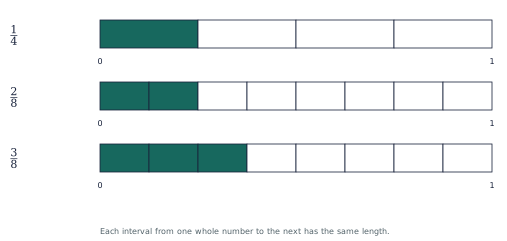
Each row represents the same whole. The first two rows show equivalent forms of the first fraction; the third shows the second fraction in the same-sized parts.
Choose the learner’s current skills. Earlier topics are always available when an idea needs revisiting. Year 10A is optional extension.
11 topic guides
Teach at home10 topic guides
Teach at home13 topic guides
Teach at home15 topic guides
Teach at home16 topic guides
Teach at home17 topic guides
Teach at home17 topic guides
Teach at home22 topic guides
Teach at home21 topic guides
Teach at home17 topic guides
Teach at home23 topic guides
Teach at home20 topic guides
Teach at home34 topic guides
Teach at home37 topic guides
Check the starting skills and gather simple materials. Read the learning goal before choosing the practice.
Use the model and a worked example. Invite the learner to point, build, sketch and explain what the numbers mean.
Try a fresh problem, compare reasoning with the worked answer, and use the guide’s checks to choose the next step.
273 teaching guides
Build understanding of counting and ordering to 20 using a model, a spoken explanation and independent practice.
NumberBuild understanding of seeing small quantities at a glance using a model, a spoken explanation and independent practice.
NumberBuild understanding of parts and wholes to 10 using a model, a spoken explanation and independent practice.
NumberBuild understanding of joining and taking away using a model, a spoken explanation and independent practice.
NumberBuild understanding of equal sharing and grouping using a model, a spoken explanation and independent practice.
NumberBuild understanding of repeating patterns and instructions using a model, a spoken explanation and independent practice.
AlgebraBuild understanding of comparing length, mass, capacity and time using a model, a spoken explanation and independent practice.
MeasurementBuild understanding of days and daily routines using a model, a spoken explanation and independent practice.
MeasurementBuild understanding of recognising and making shapes using a model, a spoken explanation and independent practice.
SpaceBuild understanding of position and location words using a model, a spoken explanation and independent practice.
SpaceBuild understanding of sorting and comparing two choices using a model, a spoken explanation and independent practice.
StatisticsBuild understanding of place value and number order to 120 using a model, a spoken explanation and independent practice.
NumberBuild understanding of skip counting and coin patterns using a model, a spoken explanation and independent practice.
AlgebraBuild understanding of addition, subtraction and missing values using a model, a spoken explanation and independent practice.
NumberBuild understanding of sharing and equal groups using a model, a spoken explanation and independent practice.
NumberBuild understanding of repeating units and pattern mistakes using a model, a spoken explanation and independent practice.
AlgebraBuild understanding of measuring fairly with informal units using a model, a spoken explanation and independent practice.
MeasurementBuild understanding of calendar units and elapsed days using a model, a spoken explanation and independent practice.
MeasurementBuild understanding of shape features and classification using a model, a spoken explanation and independent practice.
SpaceBuild understanding of maps, locations and clear directions using a model, a spoken explanation and independent practice.
SpaceBuild understanding of collecting and displaying class data using a model, a spoken explanation and independent practice.
StatisticsBuild understanding of place value and number order to 1,000 using a model, a spoken explanation and independent practice.
NumberBuild understanding of halves, quarters and eighths using a model, a spoken explanation and independent practice.
NumberBuild understanding of addition, subtraction and missing values using a model, a spoken explanation and independent practice.
NumberBuild understanding of multiplication, division and fact families using a model, a spoken explanation and independent practice.
NumberBuild understanding of money totals and practical problems using a model, a spoken explanation and independent practice.
NumberBuild understanding of number patterns and step-by-step rules using a model, a spoken explanation and independent practice.
AlgebraBuild understanding of measuring fairly with informal units using a model, a spoken explanation and independent practice.
MeasurementBuild understanding of calendar units and elapsed days using a model, a spoken explanation and independent practice.
MeasurementBuild understanding of hours, half-hours and quarter-hours using a model, a spoken explanation and independent practice.
MeasurementBuild understanding of quarter, half and full turns using a model, a spoken explanation and independent practice.
MeasurementBuild understanding of shape features and classification using a model, a spoken explanation and independent practice.
SpaceBuild understanding of maps, locations and clear directions using a model, a spoken explanation and independent practice.
SpaceBuild understanding of collecting and displaying class data using a model, a spoken explanation and independent practice.
StatisticsBuild understanding of odd and even numbers and their patterns using a model, a spoken explanation and independent practice.
NumberBuild understanding of place value and number order to 100,000 using a model, a spoken explanation and independent practice.
NumberBuild understanding of unit fractions and making a whole using a model, a spoken explanation and independent practice.
NumberBuild understanding of addition, subtraction and missing values using a model, a spoken explanation and independent practice.
NumberBuild understanding of multiplication, division and fact families using a model, a spoken explanation and independent practice.
NumberBuild understanding of estimating quantities and checking sums using a model, a spoken explanation and independent practice.
NumberBuild understanding of money totals and practical problems using a model, a spoken explanation and independent practice.
NumberBuild understanding of number patterns and step-by-step rules using a model, a spoken explanation and independent practice.
AlgebraBuild understanding of metric measures and useful benchmarks using a model, a spoken explanation and independent practice.
MeasurementBuild understanding of reading clocks and converting time using a model, a spoken explanation and independent practice.
MeasurementBuild understanding of angles as turns and right-angle benchmarks using a model, a spoken explanation and independent practice.
MeasurementBuild understanding of solid objects and geometric properties using a model, a spoken explanation and independent practice.
SpaceBuild understanding of maps, locations and clear directions using a model, a spoken explanation and independent practice.
SpaceBuild understanding of collecting and displaying class data using a model, a spoken explanation and independent practice.
StatisticsBuild understanding of chance language and experiments using a model, a spoken explanation and independent practice.
ProbabilityBuild understanding of tenths, hundredths and decimal order using a model, a spoken explanation and independent practice.
NumberBuild understanding of multiplication, division and fact families using a model, a spoken explanation and independent practice.
NumberBuild understanding of equivalent fractions and mixed numbers using a model, a spoken explanation and independent practice.
NumberBuild understanding of multiplying and dividing by tens and hundreds using a model, a spoken explanation and independent practice.
NumberBuild understanding of four operations and equivalent equations using a model, a spoken explanation and independent practice.
NumberBuild understanding of money totals and practical problems using a model, a spoken explanation and independent practice.
NumberBuild understanding of number patterns and step-by-step rules using a model, a spoken explanation and independent practice.
AlgebraBuild understanding of reading scales and partial units using a model, a spoken explanation and independent practice.
MeasurementBuild understanding of measuring boundaries and covering regions using a model, a spoken explanation and independent practice.
MeasurementBuild understanding of elapsed time with am and pm using a model, a spoken explanation and independent practice.
MeasurementBuild understanding of naming and estimating angles using a model, a spoken explanation and independent practice.
MeasurementBuild understanding of solid objects and geometric properties using a model, a spoken explanation and independent practice.
SpaceBuild understanding of maps, locations and clear directions using a model, a spoken explanation and independent practice.
SpaceBuild understanding of line and rotational symmetry using a model, a spoken explanation and independent practice.
SpaceBuild understanding of collecting and displaying class data using a model, a spoken explanation and independent practice.
StatisticsBuild understanding of likelihood, experiments and variation using a model, a spoken explanation and independent practice.
ProbabilityBuild understanding of decimals beyond hundredths using a model, a spoken explanation and independent practice.
NumberBuild understanding of factors, multiples and divisibility algorithms using a model, a spoken explanation and independent practice.
NumberBuild understanding of comparing, adding and subtracting fractions using a model, a spoken explanation and independent practice.
NumberBuild understanding of connecting fractions, decimals and percentages using a model, a spoken explanation and independent practice.
NumberBuild understanding of multiplying larger whole numbers using a model, a spoken explanation and independent practice.
NumberBuild understanding of division, remainders and missing values using a model, a spoken explanation and independent practice.
NumberBuild understanding of budgets, estimates and financial decisions using a model, a spoken explanation and independent practice.
NumberBuild understanding of choosing metric units and precision using a model, a spoken explanation and independent practice.
MeasurementBuild understanding of perimeter, area and composite shapes using a model, a spoken explanation and independent practice.
MeasurementBuild understanding of 12-hour and 24-hour time using a model, a spoken explanation and independent practice.
MeasurementBuild understanding of measuring and constructing angles using a model, a spoken explanation and independent practice.
MeasurementBuild understanding of nets of prisms and pyramids using a model, a spoken explanation and independent practice.
SpaceBuild understanding of coordinates in the first quadrant using a model, a spoken explanation and independent practice.
SpaceBuild understanding of translations, reflections and rotations using a model, a spoken explanation and independent practice.
SpaceBuild understanding of data types, distributions and investigations using a model, a spoken explanation and independent practice.
StatisticsBuild understanding of reading and drawing time-series line graphs using a model, a spoken explanation and independent practice.
StatisticsBuild understanding of equally likely outcomes and frequencies using a model, a spoken explanation and independent practice.
ProbabilityBuild understanding of integers and the four-quadrant plane using a model, a spoken explanation and independent practice.
SpaceBuild understanding of prime, composite, square and triangular numbers using a model, a spoken explanation and independent practice.
NumberBuild understanding of comparing, adding and subtracting fractions using a model, a spoken explanation and independent practice.
NumberBuild understanding of decimal operations and place-value checks using a model, a spoken explanation and independent practice.
NumberBuild understanding of fractions, decimals and percentages of amounts using a model, a spoken explanation and independent practice.
NumberBuild understanding of budgets, estimates and financial decisions using a model, a spoken explanation and independent practice.
NumberBuild understanding of number patterns and step-by-step rules using a model, a spoken explanation and independent practice.
AlgebraBuild understanding of order of operations and equivalent equations using a model, a spoken explanation and independent practice.
AlgebraBuild understanding of converting metric units with decimals using a model, a spoken explanation and independent practice.
MeasurementBuild understanding of area and perimeter of rectangles using a model, a spoken explanation and independent practice.
MeasurementBuild understanding of timetables, itineraries and elapsed time using a model, a spoken explanation and independent practice.
MeasurementBuild understanding of unknown angles and angle relationships using a model, a spoken explanation and independent practice.
MeasurementBuild understanding of cross-sections of right prisms using a model, a spoken explanation and independent practice.
SpaceBuild understanding of transformations and tessellating patterns using a model, a spoken explanation and independent practice.
SpaceBuild understanding of data types, distributions and investigations using a model, a spoken explanation and independent practice.
StatisticsBuild understanding of evaluating graphs and statistical claims using a model, a spoken explanation and independent practice.
StatisticsBuild understanding of probability scales and simulations using a model, a spoken explanation and independent practice.
ProbabilityConnect square arrays, square numbers and positive square roots.
NumberWrite numbers using powers of ten and prime factors.
NumberCompare rational numbers and connect fractions, decimals and percentages.
NumberChoose useful rounding and estimate to check calculations.
NumberCalculate with positive fractions and decimals using efficient operations.
NumberFind percentages of quantities and express comparisons as percentages.
NumberUse order and directed movement to add and subtract integers.
NumberShare quantities in ratios and model comparisons of lengths, areas and volumes.
NumberBuild and explain a simple model for comparing purchases.
NumberSubstitute into formulas and investigate how variables affect results.
AlgebraUse algebraic expressions and arithmetic laws to organise calculations.
AlgebraUndo operations to solve one-variable equations and verify solutions.
AlgebraLink rules, tables, coordinates and the story a graph tells.
AlgebraUse perpendicular heights to find areas of rectangles, triangles and parallelograms.
MeasurementFind prism volume from a repeated cross-section.
MeasurementConnect the radius, diameter and circumference of a circle.
MeasurementUse angle relationships and polygon angle sums with reasons.
MeasurementInterpret nets and orthogonal views of three-dimensional objects.
SpaceClassify polygons using properties and explicit decision rules.
SpaceDescribe translations, reflections and quarter-turn rotations using coordinates.
SpaceSummarise numerical data and choose a display for an investigation.
StatisticsList outcomes, assign probabilities and compare expected with observed frequencies.
ProbabilityDistinguish rational numbers from irrational numbers in measurements.
NumberApply exponent laws to numerical powers with the same base.
NumberConvert between fractions and terminating or recurring decimals.
NumberCalculate with signed fractions, decimals and integers.
NumberCalculate percentage increase, decrease and measurement error.
NumberModel revenue, costs and profit using rational numbers and linear rules.
NumberExpand, simplify and factorise linear expressions.
AlgebraConnect linear rules, graphs, equations and inequalities.
AlgebraTrace algorithms and use test cases to find and correct errors.
AlgebraBreak composite shapes into useful parts and track external boundaries.
MeasurementConnect prism volume to capacity using consistent metric units.
MeasurementChoose between circle area and circumference formulas.
MeasurementCalculate elapsed time across midnight and stated time-zone offsets.
MeasurementCompare quantities in different units and model constant-speed travel.
MeasurementFind missing sides in right-angled triangles.
MeasurementIdentify congruent and similar triangles and test decision rules.
SpaceExplain quadrilateral properties through angles and congruent triangles.
SpaceUse ordered triples to describe locations in three-dimensional space.
SpaceCompare sampling methods and recognise sampling variability.
StatisticsPlan an ethical sample-based investigation and report uncertainty.
StatisticsRepresent two-event outcomes and use complements to calculate probabilities.
ProbabilityWork with rational and irrational numbers while distinguishing exact and approximate results.
NumberApply exponent laws to numbers and variables, including negative exponents.
AlgebraExpand binomial products and factorise monic quadratic expressions.
AlgebraSolve linear equations and sketch lines in different algebraic forms.
AlgebraCalculate the gradient, midpoint and distance between two points.
AlgebraConnect quadratic factors, roots, turning points and changes in parameters.
AlgebraChoose and evaluate linear or quadratic models, including simple interest.
AlgebraCalculate exposed surface area and volume of prisms and cylinders.
MeasurementRepresent very large and small measurements using scientific notation.
MeasurementUse similar triangles to explain and apply sine, cosine and tangent.
MeasurementDistinguish absolute, relative and percentage error.
MeasurementUse scale factors, proportional reasoning and measurement models.
MeasurementDesign and test geometric algorithms using explicit conditions.
SpaceEvaluate how survey design influences estimates and reported conclusions.
StatisticsCompare centre, spread, shape and outliers using appropriate displays.
StatisticsConduct and evaluate an investigation using different data types.
StatisticsCompare replacement rules, combined events and simulated probabilities.
ProbabilityCompare exact calculation with repeated approximation.
NumberFactor algebraic expressions and simplify products and quotients.
AlgebraOperate on algebraic fractions and solve equations with stated restrictions.
AlgebraExpand and factor monic quadratics and solve related equations.
AlgebraMake a chosen variable the subject and solve formula-based problems.
AlgebraUse lists and tables to organise mathematical algorithms.
AlgebraSolve and represent linear inequalities with correct boundary notation.
AlgebraFind intersections using substitution, elimination and graphs.
AlgebraUse gradients to classify and construct lines.
AlgebraConnect equations and graphs of several non-linear relations.
AlgebraSolve simple exponential equations and model repeated proportional change.
AlgebraApproximate roots and check whether every solution has been found.
AlgebraCombine solids while distinguishing enclosed volume from exposed area.
MeasurementInterpret logarithmic scales as multiplicative comparisons.
MeasurementModel direction and vertical angles using right-triangle trigonometry.
MeasurementModel proportional relationships and evaluate scaling and measurement assumptions.
MeasurementBuild geometric arguments from stated facts and established theorems.
SpaceRepresent practical relationships using vertices and edges.
SpaceCompare numerical distributions using quartiles and boxplots.
StatisticsInvestigate relationships between numerical variables and time series.
StatisticsCompare categorical variables using proportions within appropriate groups.
StatisticsCheck whether data, displays and sampling support a public claim.
StatisticsInterpret conditioning and compare dependent and independent multi-stage events.
ProbabilitySimplify surds and interpret rational exponents.
NumberUse logarithm laws and the inverse relationship with exponentials.
NumberUse factor and remainder theorems and connect roots to polynomial graphs.
AlgebraDesign numerical algorithms and simulations with explicit accuracy and assumptions.
AlgebraSimplify and solve linear expressions with rational coefficients.
AlgebraDescribe transformed parabolas, hyperbolas, circles and exponentials.
AlgebraSolve non-monic quadratic equations and interpret roots.
AlgebraUse function notation with domains, ranges and contextual inputs.
AlgebraFind intersections of linear and non-linear relations.
AlgebraUse formulas for pyramids, cones, spheres and related composites.
MeasurementCompare average rates of change and investigate a limiting instantaneous rate.
MeasurementUse circle theorems with stated arc conditions and justify angle relationships.
SpaceSolve non-right triangles with the sine rule, cosine rule and included-angle area formula.
SpaceExtend trigonometry using the unit circle, radians, graphs and specified solution intervals.
SpaceIdentify perpendicular planes and use right triangles to solve spatial problems.
SpaceDesign, test and refine algorithms for routes, layouts and spatial constraints.
SpaceCompare distributions using standard deviation, quantiles and other measures of spread.
StatisticsFit and assess straight-line models for paired numerical data using digital tools.
StatisticsCount ordered and unordered outcomes and connect counting to equally likely probabilities.
ProbabilityEvaluate reports by examining sampling, implementation, graphs and the claims supported by evidence.
ProbabilityChoose a display to match the variable. Categories need separate bars; numerical measurements can be grouped into intervals in a histogram.
Data analysis, probability and statisticsDescribe a numerical distribution using shape, centre and spread. A mean uses every value; a median is less affected by extreme observations.
Data analysis, probability and statisticsAn arithmetic sequence adds a fixed amount each step:  =
 +nd. A geometric sequence multiplies by a fixed factor: =
 .
Use a multiplier for a percentage change. Reverse a percentage by dividing by the multiplier, not by subtracting the same percentage.
Algebra, number and structureIn y=a+bx, a is the value at x=0 and b is the change in y for a one-unit increase in x. Choose a realistic domain for any contextual model.
Functions, relations and graphsA matrix stores a rectangular array of values. Addition needs equal dimensions; AB is defined when the columns of A equal the rows of B.
Discrete mathematicsA column transition matrix T uses each column to describe where people in one current state move next. Then  =TS_n.
A scatterplot pairs each explanatory value x with its response y. Describe direction, form and strength before fitting a line.
Data analysis, probability and statisticsGraphs represent objects as vertices and connections as edges. A path does not repeat vertices; a trail does not repeat edges.
Discrete mathematicsDirect variation y=kx has a constant ratio  . Inverse variation y=
 has a constant product xy.
Match each formula to the correct length, angle or shape. Keep exact expressions until the final requested rounding.
Space and measurementUse numerical summaries and a suitable display to compare distributions. Sample standard deviation divides the squared-deviation total by n −1.
Data analysis, probability and statisticsChoose the comparison for the variable types: two-way percentages for categories, side-by-side numerical summaries for groups, and scatterplots for paired numerical values.
Data analysis, probability and statisticsThe least-squares line minimises the sum of squared vertical residuals. Its slope is b=r( ), with intercept a=ybar −b xbar.
A time series records values in time order. Separate long-term trend, recurring seasonal movement and irregular variation.
Data analysis, probability and statisticsA recurrence  =R +d models repeated percentage change and fixed additions or deductions. Choose a period and label .
For end-of-period repayments A at interest i per period, balance  =(1+i)
 −A. Interest is calculated before each repayment.
A regular saving model with an end-period deposit A follows =(1+i) +A. Separate the initial balance from later deposits.
Matrix products can count two-step connections or combine tabular data. Define whether rows or columns describe origin before interpreting entries.
Discrete mathematicsA state column can contain categories or age classes. Transition matrices preserve totals in closed probability models, whereas Leslie matrices may include births and deaths.
Discrete mathematicsAn Euler trail uses each edge once; a Hamiltonian path visits each vertex once. These answer different travel questions.
Discrete mathematicsA minimum spanning tree connects every vertex with least total edge weight and no cycle. Prim’s algorithm repeatedly connects a new vertex by the cheapest available edge.
Discrete mathematicsAssignment problems match each person or machine to one task while minimising cost or maximising benefit. Check all constraints, not just the cheapest individual entries.
Discrete mathematicsA function assigns one output to each allowed input. Its domain is part of its definition; its range contains the outputs actually achieved.
Functions, relations and graphsStart with a known power graph, such as  ,
 ,
 ,
 or
 , and track its key points and domain.
A root r of polynomial P gives a factor x −r. The remainder on division by x −r is P(r), so substitution tests a proposed factor.
Algebra, number and structureA parameter labels a family of rules; a variable ranges over values within one chosen rule. Use the given conditions to determine parameters.
Algebra, number and structureAverage rate of change over [a, b] is  . Geometrically it is a secant gradient.
The multiplication principle counts sequential choices; the addition principle combines disjoint alternatives. Before counting, decide whether order matters.
Data analysis, probability and statisticsRadians measure angle using arc length divided by radius: θ= . A full turn is 2 π radians.
An exponential model multiplies by a fixed factor over equal intervals. Logarithms invert exponentiation and help solve for the exponent.
Algebra, number and structureThe derivative of  is nxn −1 for a polynomial power. Stationary points satisfy f′(x)=0, but classifying them needs a sign test or other reasoning.
Conditioning reduces the sample space. P(A |B)= when P(B)>0; it generally differs from P(B |A).
Track domain, range, intercepts, symmetry and asymptotes as a function is transformed. In y=A f(n(x+b))+c, a parent point (u, v) maps to ( −b, Av+c).
The composition f∘g applies g first. It is defined when the range of g lies within the domain of f; restrictions can be needed.
Algebra, number and structureCombine basic derivatives with the chain, product and quotient rules. A nested function requires multiplying by the derivative of the inner function.
CalculusFind stationary points by solving f′=0, then analyse sign changes or curvature. A point of inflection requires a change in concavity; f′′=0 alone is not sufficient.
CalculusReverse known derivatives to find anti-derivatives. For f(ax+b), account for the inner linear gradient; check by differentiating your answer.
CalculusA definite integral gives signed accumulation. Geometric area requires positive contributions and may need splitting at intersections or axis crossings.
CalculusA probability mass function lists the chance of each possible value. Probabilities must be non-negative and sum to 1.
Data analysis, probability and statisticsA probability density is non-negative and has total area 1. Probability over an interval is area under the density; the density height itself is not a probability.
Data analysis, probability and statisticsWrite X~N(μ, σ2), so the second parameter is variance. Standardise using Z= , then use a normal CDF or inverse CDF.
For independent Bernoulli trials, the sample proportion phat= has mean p and SD
 . A normal approximation requires a large suitable sample with enough expected successes and failures.
A proof establishes a statement for every case in its stated domain. Examples can suggest a conjecture, but one counterexample disproves a universal statement.
Algebra, number and structureThe handshaking lemma counts every undirected edge at both ends: the sum of degrees is 2 E. A loop contributes 2 to its vertex degree.
Algebra, number and structureLogical implication p⇒q is false only when p is true and q is false. Boolean operations AND, OR and NOT can be represented by truth tables or logic circuits.
Algebra, number and structureAn arithmetic series sums terms with a constant difference; a geometric series sums terms with a constant ratio. Distinguish the nth term from the sum of the first n terms.
Discrete mathematicsUse permutations for ordered arrangements and combinations for unordered selections. Repeated identical objects reduce the number of distinct arrangements.
Discrete mathematicsMatrix multiplication is associative and distributive but generally not commutative. Matrix equations must preserve order when multiplying by inverses.
Discrete mathematicsA sample mean changes when a new random sample is drawn. Its sampling distribution describes this variation, rather than the distribution of the original observations.
Data analysis, probability and statisticsCompound-angle identities connect trig values of sums and differences. Double-angle identities are special cases and support exact values and equation solving.
Space and measurementA linear transformation maps a column vector using a 2×2 matrix; translations add a vector. Apply compositions from right to left in matrix products.
Space and measurementA vector has magnitude and direction. Add components to combine displacements or velocities; subtract to form relative quantities.
Space and measurementWrite z=a+bi with  =−1. Its modulus is
 ; conjugation changes the sign of the imaginary component.
Partial fractions split a rational expression into simpler terms. Match numerator coefficients after putting the proposed parts over a common denominator.
Functions, relations and graphsA locus describes points satisfying a geometric condition. Circles, parabolas, ellipses and hyperbolas have recognisable Cartesian equations and useful parametric forms.
Functions, relations and graphsA proof establishes a statement for every case in its stated domain. An example can support a conjecture, but a single counterexample disproves a universal claim. Distinguish an implication from its converse and distinguish necessary conditions from sufficient conditions.
Discrete mathematicsFind the domain before simplifying a quotient. A cancelled factor may create a hole rather than a vertical asymptote; preserve the original exclusion. Polynomial division identifies oblique asymptotes when the numerator has one higher degree than the denominator.
Functions, relations and graphsWrite a nonzero complex number as r cis θ, where cis θ=cos θ+i sin θ. De Moivre’s theorem gives (r cis θ)n= cis(nθ) for integer n. Multiplication adds arguments and multiplies moduli.
When y depends on x, differentiate an implicit relation using the chain rule on every y term. For example,  =2 y y′. Collect the y′ terms before solving. The formula may fail where its denominator vanishes.
Choose the technique from the structure. An inner expression with its derivative suggests substitution; a product such as x  suggests integration by parts; a rational function may simplify by division or partial fractions.
Integration adds small geometric contributions. A region’s area is the integral of upper minus lower height. A volume from discs or washers is the integral of π times the difference of squared radii; the radius is measured to the stated axis.
CalculusA differential equation connects a quantity with its rate of change. Initial conditions select a particular solution. For a separable equation y′=f(x)g(y), separate the variables and integrate, while checking equilibrium solutions that division by g(y) may exclude.
CalculusFor position x(t), velocity is v= and acceleration is a=
 . Displacement is the signed integral of velocity; distance travelled is the integral of |v | and usually requires splitting at direction changes.
A three-dimensional vector can be represented by its components in orthogonal unit directions. The dot product measures alignment and gives projections; the cross product is perpendicular to both input vectors and has magnitude equal to their spanned parallelogram area.
Space and measurementA line through position a with direction d has vector equation r=a+td. A plane through a with independent directions u, v has r=a+su+tv. A nonzero normal n perpendicular to both directions gives n·(r −a)=0.
Space and measurementDifferentiate or integrate a vector function component by component. Velocity is r′(t), acceleration is r′′(t), and speed is |r′(t)|. An initial position supplies the integration constants needed to recover a position vector from velocity.
Space and measurementExpected values are linear: E(a X+b Y+c)=a E(X)+b E(Y)+c. For independent X and Y, Var(a X+b Y+c)= Var(X)+
 Var(Y). A constant changes the mean but does not add variability.
The sample mean is a random variable before data are collected. For n independent observations from the same population with mean μ and finite variance σ2, its mean is μ and its standard deviation, or standard error, is  .
A normal-based interval for a population mean has the form xbar ± when population SD σ is known and the normal sampling model is justified. For sufficiently large random samples, s may replace σ to form the approximation.
State the null and alternative hypotheses before examining the result. For a normal population with known σ, or an appropriate large-sample approximation, standardise the sample mean as z= . Match the tail or tails to the alternative hypothesis.
No guides match. Try a broader word or choose another level.
These free guides support the mathematics part of your family’s learning. The year labels and topic descriptions help you choose a starting point. VRQA explains that families can choose the curriculum and learning approach that suits their child. See the official learning-plan guidance and home-education resources for broader planning.