Check the starting point
- Distinguish a flat shape from a solid object
- Classify by geometric properties rather than appearance
Show the idea
Read a rectangular prism
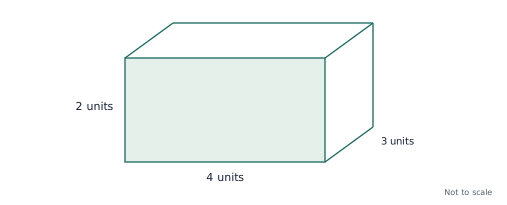
Opposite faces match. This prism has faces 4 × 3, 4 × 2 and 3 × 2 units, with two of each. Illustration not to scale.
Work through an example
Use the labelled model to explain: read a rectangular prism.
- Classify a shape or object using its properties, such as sides, corners, faces, edges and curved surfaces. Its colour, size or direction does not determine its name.
- Opposite faces match. This prism has faces 4 × 3, 4 × 2 and 3 × 2 units, with two of each. Illustration not to scale.
Answer: Opposite faces match. This prism has faces 4 × 3, 4 × 2 and 3 × 2 units, with two of each. Illustration not to scale.
Teach in small steps
- Check the starting skill together: Distinguish a flat shape from a solid object. If this is uncertain, use the objects or drawings before beginning the worksheet.
- Gather a box, a ball and paper shapes. Ask your child to trace a face or boundary and count the relevant features.
- Rotate each example and repeat the classification. Explain that turning an object does not change its face shapes or corner count.
- Let your child attempt this fresh example: How many vertices and edges does a cube have? Ask them to show the representation before checking the solution. Then use the application and checkpoint pages on later sessions.
Ask and listen
- Which has one flat circular base: a cone or a cylinder?
- What part of the model helps you check your answer?
Adapt the practice
More support
Keep the labelled model beside the problem. Let your child describe each step aloud before writing the calculation.
More challenge
Change one quantity in the example, predict what changes, and check the prediction with a second representation.
Look for understanding
- Your child can classify by geometric properties rather than appearance.
- Your child can explain this point and use it in a fresh problem: Squares belong to the rectangle family; not every rectangle is a square.
Choose the next step
When your child can explain the model and complete fresh practice with little help, use the application problems. If the checkpoint reveals uncertainty, return to this starting skill: Distinguish a flat shape from a solid object.
Put the idea into practice
The matching topic collection includes learn-and-practise, application and checkpoint PDFs with worked answers. Download the free preview to see representative pages.
Explore this topic’s worksheets