 =2 y y′. Collect the y′ terms before solving. The formula may fail where its denominator vanishes.
Check the starting point
- Use the chain rule when y depends on x.
- Retain changing quantities until differentiating in time.
Show the idea
An implicit circle has two branches
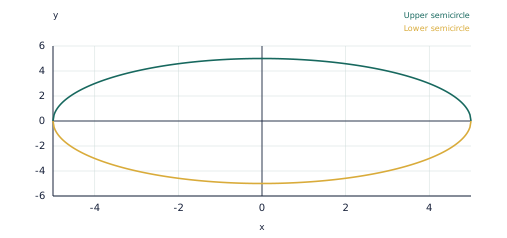
The circle  +
 =25 has y′=
 when y≠0. At (3,4), the tangent gradient is
 . The derivative formula cannot be used at y=0.
Work through an example
For  +
 =25, find
 at (3, 4).
- Differentiate +=25 with respect to x. Since y depends on x, the chain rule gives 2x+2y()=0.
- Rearrange: 2y()=-2x, so =
 where y≠0.
- The point (3,4) lies on the curve because
 +
 =25. Substitute it into the derivative: =
 .
Answer: .
Teach in small steps
- Read the visual model together: The circle +=25 has y′= when y≠0. At (3,4), the tangent gradient is . The derivative formula cannot be used at y=0.
- Model this example aloud: Differentiate y=arctan(2x−1). Guide: Multiply the inverse-tangent derivative by the inner gradient 2. Result:
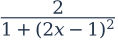 .
- Let your learner choose the steps for a new situation: A sphere’s radius grows at 0.5 cm/s. Find its volume rate when r=4 cm. Ask which part of the model or rule carries over before checking the worked solution.
- After a short break, ask for an independent response: Differentiate arcsin(
 ), stating the derivative’s domain. Compare both the method and conclusion with the checkpoint answers, then revisit any misconception.
Ask and listen
- For +xy+=3, find y′ at (1,1).
- For y=
 −3x, find y′′ and all intervals of upward concavity.
Adapt the practice
More support
Start with this prerequisite: Use the chain rule when y depends on x. Keep the visual visible. For the first guided problem, focus on this step: Multiply the inverse-tangent derivative by the inner gradient 2.
More challenge
Try this application without looking at its answer: A 13 m ladder has its foot moving away at 0.6 m/s. Find the top’s vertical velocity when the foot is 5 m from the wall. Then explain why the answer fits the stated domain or context.
Look for understanding
- Your learner can complete this checkpoint and explain the method: Differentiate arcsin(), stating the derivative’s domain.
- Your learner can justify or challenge this statement/question using the mathematical definitions: For y=−3x, find y′′ and all intervals of upward concavity.
Choose the next step
If either checkpoint needs prompting, repeat the worked model with changed values and revisit this caution: Differentiating a y term implicitly requires the factor . When both are secure, use the linked Apply and extend resource and relevant VCE Key Knowledge/Key Skills activity.
Put the idea into practice
The matching topic collection includes learn-and-practise, application and checkpoint PDFs with worked answers. Download the free preview to see representative pages.
Explore this topic’s worksheets