 . Geometrically it is a secant gradient.
Check the starting point
- Calculate a gradient as change in output divided by change in input.
- Read the units of the two axes.
Show the idea
A secant compares two inputs
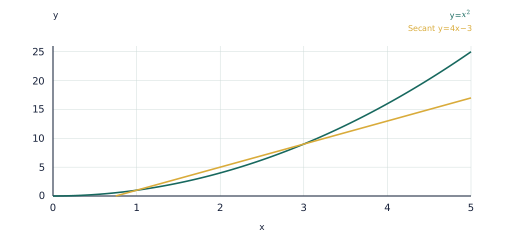
For y= , the average rate over [1,3] is
 =4. The secant joins (1,1) and (3,9).
Work through an example
For f(t)= , find average rate from t=2 to 5.
- The average rate of change on [2,5] is
 .
- Evaluate the outputs: f(5)=25 and f(2)=4. The change in output is 21 and the change in input is 3.
- Therefore the average rate is
 =7. Geometrically, this is the gradient of the secant joining (2,4) and (5,25).
Answer: 7.
Teach in small steps
- Read the visual model together: For y=, the average rate over [1,3] is =4. The secant joins (1,1) and (3,9).
- Model this example aloud: Find the average rate of f(x)=
 +1 over [1,4]. Guide: The outputs are 2 and 17. Their change 15 is divided by input change 3. Result: 5.
- Let your learner choose the steps for a new situation: Estimate the tangent gradient of f(x)= at x=4 using x=3.9 and 4.1. Ask which part of the model or rule carries over before checking the worked solution.
- After a short break, ask for an independent response: Find the equation of a tangent through (3,10) with gradient 5. Compare both the method and conclusion with the checkpoint answers, then revisit any misconception.
Ask and listen
- A water level rises from 14 cm to 26 cm in 8 minutes. Find the average rate with units.
- A graph is increasing but flattening. What can be said about its gradient?
Adapt the practice
More support
Start with this prerequisite: Calculate a gradient as change in output divided by change in input. Keep the visual visible. For the first guided problem, focus on this step: The outputs are 2 and 17. Their change 15 is divided by input change 3.
More challenge
Try this application without looking at its answer: Temperature falls from 30°C to 24°C in 2 hours and then to 21°C in 3 hours. Compare the average cooling rates. Then explain why the answer fits the stated domain or context.
Look for understanding
- Your learner can complete this checkpoint and explain the method: Find the equation of a tangent through (3,10) with gradient 5.
- Your learner can justify or challenge this statement/question using the mathematical definitions: A graph is increasing but flattening. What can be said about its gradient?
Choose the next step
If either checkpoint needs prompting, repeat the worked model with changed values and revisit this caution: An average rate is a secant gradient; an instantaneous rate is a tangent gradient. When both are secure, use the linked Apply and extend resource and relevant VCE Key Knowledge/Key Skills activity.
Put the idea into practice
The matching topic collection includes learn-and-practise, application and checkpoint PDFs with worked answers. Download the free preview to see representative pages.
Explore this topic’s worksheets