Check the starting point
- Find one equal fractional part of a quantity
- Distinguish the discount from the remaining price
Show the idea
Separate the saving from the amount paid
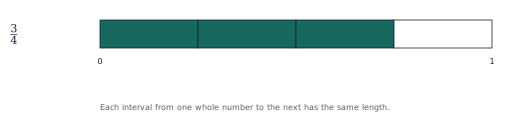
A 25% discount removes one-quarter. The three shaded quarters show the 75% still paid. For A$84, one-quarter is A$21 and three-quarters is A$63.
Work through an example
Use the bar to find the saving and price after 25% off A$84.
- The unshaded quarter represents the 25% discount. The shaded three-quarters represents the 75% still paid.
- For an original price of A$84, one-quarter is 84 ÷ 4 = A$21.
- Three-quarters is 3 × 21 = A$63. Equivalently, subtract the saving: 84 − 21 = A$63.
Answer: A$21 saved; A$63 to pay
Teach in small steps
- Check the starting skill together: Find one equal fractional part of a quantity. If this is uncertain, use the objects or drawings before beginning the worksheet.
- Represent A$84 with a bar split into four equal parts. Label each part A$21.
- Cross out one part for the 25% discount and count the three remaining parts. Connect the drawing to 0.75 × 84.
- Let your child attempt this fresh example: Find
 of 72. Ask them to show the representation before checking the solution. Then use the application and checkpoint pages on later sessions.
Ask and listen
- Find 30% of A$150.
- What part of the model helps you check your answer?
Adapt the practice
More support
Use the model to explain each named feature before introducing a fresh question. Keep the scale, units and conditions visible.
More challenge
Ask your child to change one condition and decide whether the original conclusion still follows. Require a labelled example or counterexample.
Look for understanding
- Your child can distinguish the discount from the remaining price.
- Your child can explain this point and use it in a fresh problem: A 20% discount is the saving, not the amount to pay; the remaining price is 80% of the original.
Choose the next step
When your child can explain the model and complete fresh practice with little help, use the application problems. If the checkpoint reveals uncertainty, return to this starting skill: Find one equal fractional part of a quantity.
Put the idea into practice
The matching topic collection includes learn-and-practise, application and checkpoint PDFs with worked answers. Download the free preview to see representative pages.
Explore this topic’s worksheets