Check the starting point
- List what can and cannot happen under a stated model
- Distinguish a possible outcome from a guaranteed result
Show the idea
Count outcomes before judging likelihood
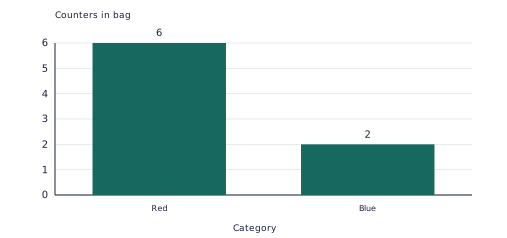
A bag contains 6 red and 2 blue identical counters. There are more equally selectable red counters, so red is more likely; blue remains possible.
Work through an example
Read the bar graph. Find the combined count and the category or categories with the greatest value.
- Add the displayed values: 6 + 2 = 8.
- Compare heights against the labelled scale. The greatest value is 6.
- A bag contains 6 red and 2 blue identical counters. There are more equally selectable red counters, so red is more likely; blue remains possible.
Answer: Total 8; greatest: Red
Teach in small steps
- Check the starting skill together: List what can and cannot happen under a stated model. If this is uncertain, use the objects or drawings before beginning the worksheet.
- Put six red and two blue counters in an opaque bag. Count the contents before predicting which colour is more likely.
- Draw, record, replace and mix for each trial. Compare observed counts with the contents without expecting an exact short-run split.
- Let your child attempt this fresh example: Bag A has 6 red and 4 blue counters. Bag B has 2 red and 8 blue. Which makes blue more likely? Ask them to show the representation before checking the solution. Then use the application and checkpoint pages on later sessions.
Ask and listen
- A counter is drawn and replaced before a second draw. Why should the bag be mixed again?
- What part of the model helps you check your answer?
Adapt the practice
More support
Use chance language and visible counter counts before introducing fractional probability. Make the replacement rule explicit.
More challenge
Create a fresh example, state the rule or relationship it uses, and verify it with a second method.
Look for understanding
- Your child can distinguish a possible outcome from a guaranteed result.
- Your child can explain this point and use it in a fresh problem: A short run does not have to match an expected split, and earlier independent outcomes do not make the opposite result “due”.
Choose the next step
When your child can explain the model and complete fresh practice with little help, use the application problems. If the checkpoint reveals uncertainty, return to this starting skill: List what can and cannot happen under a stated model.
Put the idea into practice
The matching topic collection includes learn-and-practise, application and checkpoint PDFs with worked answers. Download the free preview to see representative pages.
Explore this topic’s worksheets