Check the starting point
- Recognise reflected halves that coincide
- Identify a rotation centre and a full turn
Show the idea
Test a rectangle by folding and turning
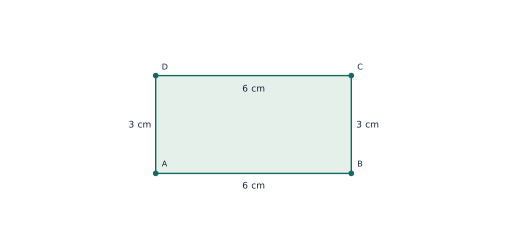
This non-square rectangle has two reflection lines through opposite side midpoints. It matches after a half-turn, giving rotational order 2.
Work through an example
Use the labelled rectangle to find both its area and its perimeter.
- Area counts equal square units: 6 × 3 = 18.
- Perimeter follows all four sides: 2 × (6 + 3) = 18.
- This non-square rectangle has two reflection lines through opposite side midpoints. It matches after a half-turn, giving rotational order 2.
Answer: Area 18 square units; perimeter 18 length units. Use the units printed on the figure.
Teach in small steps
- Check the starting skill together: Recognise reflected halves that coincide. If this is uncertain, use the objects or drawings before beginning the worksheet.
- Trace the rectangle and fold along its horizontal and vertical midlines. Test a diagonal and explain why it fails.
- Place the tracing over the original and rotate about the centre, recording distinct positions where the whole boundary matches.
- Let your child attempt this fresh example: How many lines of symmetry does a regular pentagon have? Ask them to show the representation before checking the solution. Then use the application and checkpoint pages on later sessions.
Ask and listen
- What is the rotational order of a non-square rectangle?
- What part of the model helps you check your answer?
Adapt the practice
More support
Use the concrete or drawn representation first, then record the matching calculation or property. Revisit one step at a time.
More challenge
Create a contrasting example that changes one feature. Explain which result or property changes and which remains fixed.
Look for understanding
- Your child can identify a rotation centre and a full turn.
- Your child can explain this point and use it in a fresh problem: Reflection symmetry and rotational symmetry are different properties; one does not automatically imply the other.
Choose the next step
When your child can explain the model and complete fresh practice with little help, use the application problems. If the checkpoint reveals uncertainty, return to this starting skill: Recognise reflected halves that coincide.
Put the idea into practice
The matching topic collection includes learn-and-practise, application and checkpoint PDFs with worked answers. Download the free preview to see representative pages.
Explore this topic’s worksheets