Check the starting point
- Express a sample count as a proportion
- Identify a target population
Show the idea
Samples can give different estimates
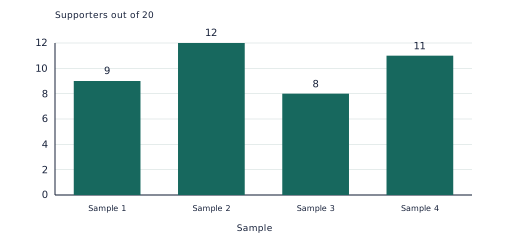
Four invented random samples of 20 produce these support counts. Variation among samples is possible even when the underlying population is unchanged.
Work through an example
Samples can give different estimates — explain the representation.
- Four invented random samples of 20 produce these support counts. Variation among samples is possible even when the underlying population is unchanged.
- Connect the labels to the calculation or rule. Random variation and systematic sampling bias are different problems.
Answer: Four invented random samples of 20 produce these support counts. Variation among samples is possible even when the underlying population is unchanged.
Teach in small steps
- Begin with a short oral check: ask your child to express a sample count as a proportion. Then check that they can identify a target population. Revisit either skill before adding a new procedure.
- Explore “Samples can give different estimates” together. Four invented random samples of 20 produce these support counts. Variation among samples is possible even when the underlying population is unchanged. Ask your child to point to the quantities or features used at each step.
- Model the example: A school samples 40 names randomly from its 800 students. Identify population and sample. Pause before each step and invite a prediction. Population: all 800 students. Sample: the 40 selected students.
- Work together on the first new practice question: A random sample contains 22 bus users among 80 students. Estimate the bus-use percentage. Have your child attempt the remaining learn questions with less help, then move to apply. Use the checkpoint on a later attempt to see which ideas are retained.
Ask and listen
- Identify population and sample in a survey of 75 randomly selected households from a town of 2400 households.
- Why can doubling a voluntary poll from 1000 to 2000 replies fail to remove self-selection bias?
Adapt the practice
More support
Return to “Samples can give different estimates” and explain one label or step at a time. Random variation and systematic sampling bias are different problems. Let your child show a calculation, drawing or spoken explanation before requiring a polished written answer.
More challenge
Try this application after the core method is secure: A survey selects every fifth name on a randomly ordered full student list. What method is this, and what should be checked? Then ask which assumption or input could be changed and what would need to be recalculated.
Look for understanding
- The learner can complete and explain this checkpoint task: Two random samples of 50 produce proportions 0.44 and 0.52. Does the difference alone prove a biased selection method?
- The learner can address the reasoning or error-checking question: Why can doubling a voluntary poll from 1000 to 2000 replies fail to remove self-selection bias? Accept a correct alternative method, but ask for the mathematical reason.
Choose the next step
If both checks can be explained without prompting, continue to Planning fair statistical investigations. If a method is still uncertain, repeat the visual example with fresh numbers before progressing.
Put the idea into practice
The matching topic collection includes learn-and-practise, application and checkpoint PDFs with worked answers. Download the free preview to see representative pages.
Explore this topic’s worksheets