Check the starting point
- Plot ordered pairs accurately
- Describe a mirror line or rotation centre
Show the idea
A reflection preserves distance from the mirror
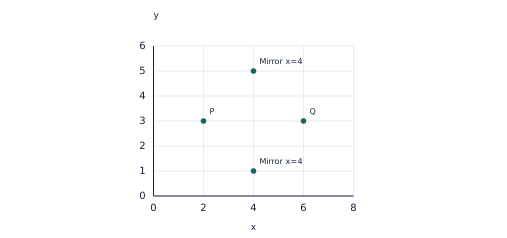
P(2, 3) and Q(6, 3) are each 2 units from the vertical mirror line x = 4. The image keeps the same y-coordinate.
Work through an example
Use the labelled model to explain: a reflection preserves distance from the mirror.
- A translation slides every point the same distance in the same direction. A reflection flips a shape across a mirror line, keeping matching points at equal perpendicular distances from the line.
- P(2, 3) and Q(6, 3) are each 2 units from the vertical mirror line x = 4. The image keeps the same y-coordinate.
Answer: P(2, 3) and Q(6, 3) are each 2 units from the vertical mirror line x = 4. The image keeps the same y-coordinate.
Teach in small steps
- Check the starting skill together: Plot ordered pairs accurately. If this is uncertain, use the objects or drawings before beginning the worksheet.
- Draw a mirror line on squared paper and count the perpendicular distance from a point to it.
- Place the image the same distance on the other side. Use tracing paper to check that reflections, translations and rotations preserve size.
- Let your child attempt this fresh example: Translate (2, 3) four right and one down. Ask them to show the representation before checking the solution. Then use the application and checkpoint pages on later sessions.
Ask and listen
- Reflect (3, 5) in the line x = 5.
- What part of the model helps you check your answer?
Adapt the practice
More support
Use the model to explain each named feature before introducing a fresh question. Keep the scale, units and conditions visible.
More challenge
Ask your child to change one condition and decide whether the original conclusion still follows. Require a labelled example or counterexample.
Look for understanding
- Your child can describe a mirror line or rotation centre.
- Your child can explain this point and use it in a fresh problem: A turn needs a centre and direction; a reflection needs a mirror line. “Turn it” alone is incomplete.
Choose the next step
When your child can explain the model and complete fresh practice with little help, use the application problems. If the checkpoint reveals uncertainty, return to this starting skill: Plot ordered pairs accurately.
Put the idea into practice
The matching topic collection includes learn-and-practise, application and checkpoint PDFs with worked answers. Download the free preview to see representative pages.
Explore this topic’s worksheets