Check the starting point
- Count in fives around a clock face
- Distinguish the hour hand from the minute hand
Show the idea
Read both hands together
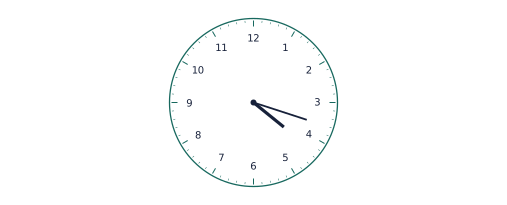
The long hand marks 18 minutes and the short hand is after 4. The time is 4:18.
Work through an example
Read a clock with the minute hand on 3 and the hour hand just after 7.
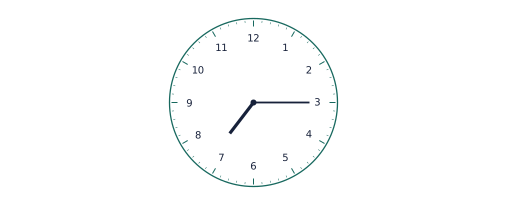
- The 3 marks 3×5=15 minutes.
- The hour hand is just after 7.
Answer: 7:15
Teach in small steps
- Check the starting skill together: Count in fives around a clock face. If this is uncertain, use the objects or drawings before beginning the worksheet.
- Move the long hand around an analogue clock and count five minutes at each numbered mark. Use the small marks for single minutes.
- Move the short hand gradually as minutes pass. Contrast half-past with the next full hour so the hour hand is not placed too far ahead.
- Let your child attempt this fresh example: Read the clock. Write the time in digits. Ask them to show the representation before checking the solution. Then use the application and checkpoint pages on later sessions.
Select the diagram to view it at full size.
Ask and listen
- How many minutes are in three quarters of an hour?
- What part of the model helps you check your answer?
Adapt the practice
More support
Keep a labelled example visible and solve one stage at a time. Return to concrete objects if the written representation is unclear.
More challenge
Create a fresh example, state the rule or relationship it uses, and verify it with a second method.
Look for understanding
- Your child can distinguish the hour hand from the minute hand.
- Your child can explain this point and use it in a fresh problem: The hour hand should be between numbers at half-past; it is not exactly on the next hour.
Choose the next step
When your child can explain the model and complete fresh practice with little help, use the application problems. If the checkpoint reveals uncertainty, return to this starting skill: Count in fives around a clock face.
Put the idea into practice
The matching topic collection includes learn-and-practise, application and checkpoint PDFs with worked answers. Download the free preview to see representative pages.
Explore this topic’s worksheets