Check the starting point
- Calculate rectangular and triangular areas
- Distinguish square units from cubic units
Show the idea
Layers make prism volume
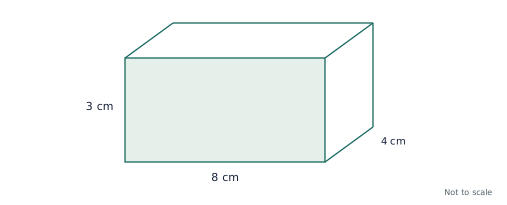
This rectangular prism has cross-sectional area 4 × 3 = 12 cm² and length 8 cm. Its volume is 12 × 8 = 96 cm³; perspective sketch not to scale.
Work through an example
Layers make prism volume — explain the representation.
- This rectangular prism has cross-sectional area 4 × 3 = 12 cm² and length 8 cm. Its volume is 12 × 8 = 96 cm³; perspective sketch not to scale.
- Connect the labels to the calculation or rule. Do not omit the half when finding a triangular cross-section.
Answer: This rectangular prism has cross-sectional area 4 × 3 = 12 cm² and length 8 cm. Its volume is 12 × 8 = 96 cm³; perspective sketch not to scale.
Teach in small steps
- Begin with a short oral check: ask your child to calculate rectangular and triangular areas. Then check that they can distinguish square units from cubic units. Revisit either skill before adding a new procedure.
- Explore “Layers make prism volume” together. This rectangular prism has cross-sectional area 4 × 3 = 12 cm² and length 8 cm. Its volume is 12 × 8 = 96 cm³; perspective sketch not to scale. Ask your child to point to the quantities or features used at each step.
- Model the example: A triangular prism has triangle base 6 cm, triangle height 4 cm and prism length 10 cm. Pause before each step and invite a prediction. Cross-section = 6 ×
 =12 cm². Volume =12 × 10.
- Work together on the first new practice question: Find the volume of a rectangular prism 7 cm long, 6 cm wide and 4 cm high. Have your child attempt the remaining learn questions with less help, then move to apply. Use the checkpoint on a later attempt to see which ideas are retained.
Ask and listen
- A right prism has cross-sectional area 16.5 cm² and length 8 cm. Find its volume.
- A learner calculates a cube of side 4 cm as 4 × 4 = 16 cm³. Explain and repair the error.
Adapt the practice
More support
Return to “Layers make prism volume” and explain one label or step at a time. Do not omit the half when finding a triangular cross-section. Let your child show a calculation, drawing or spoken explanation before requiring a polished written answer.
More challenge
Try this application after the core method is secure: A rectangular store has dimensions 6 m by 4 m by 3 m. Boxes occupy one quarter of its volume. Find the occupied volume. Then ask which assumption or input could be changed and what would need to be recalculated.
Look for understanding
- The learner can complete and explain this checkpoint task: A prism volume is 525 cm³ and its length is 15 cm. Find its cross-sectional area.
- The learner can address the reasoning or error-checking question: A learner calculates a cube of side 4 cm as 4 × 4 = 16 cm³. Explain and repair the error. Accept a correct alternative method, but ask for the mathematical reason.
Choose the next step
If both checks can be explained without prompting, continue to Circles: radius, diameter and circumference. If a method is still uncertain, repeat the visual example with fresh numbers before progressing.
Put the idea into practice
The matching topic collection includes learn-and-practise, application and checkpoint PDFs with worked answers. Download the free preview to see representative pages.
Explore this topic’s worksheets