Check the starting point
- Match corresponding angles and sides
- Calculate a common scale factor
Show the idea
A 3–4–5 reference triangle
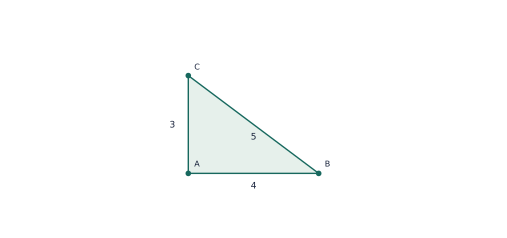
A similar enlargement with sides 6, 8, 10 has scale factor 2. Equal side ratios establish similarity; the different size prevents congruence.
Work through an example
A 3–4–5 reference triangle — explain the representation.
- A similar enlargement with sides 6, 8, 10 has scale factor 2. Equal side ratios establish similarity; the different size prevents congruence.
- Connect the labels to the calculation or rule. AAA fixes shape, not size.
Answer: A similar enlargement with sides 6, 8, 10 has scale factor 2. Equal side ratios establish similarity; the different size prevents congruence.
Teach in small steps
- Begin with a short oral check: ask your child to match corresponding angles and sides. Then check that they can calculate a common scale factor. Revisit either skill before adding a new procedure.
- Explore “A 3–4–5 reference triangle” together. A similar enlargement with sides 6, 8, 10 has scale factor 2. Equal side ratios establish similarity; the different size prevents congruence. Ask your child to point to the quantities or features used at each step.
- Model the example: Compare triangles with sides 3,4,5 and 6,8,10. Pause before each step and invite a prediction. Side ratios are all 2. The sizes differ.
- Work together on the first new practice question: Triangles have corresponding sides 5, 12, 13 and 15, 36, 39. Are they similar? Find the scale factor. Have your child attempt the remaining learn questions with less help, then move to apply. Use the checkpoint on a later attempt to see which ideas are retained.
Ask and listen
- Two triangles have corresponding angles 35°, 65° and 80°. What can be concluded about similarity and congruence?
- A student checks only one pair of corresponding sides to claim similarity. Give two valid triangles that show why this is insufficient.
Adapt the practice
More support
Return to “A 3–4–5 reference triangle” and explain one label or step at a time. AAA fixes shape, not size. Let your child show a calculation, drawing or spoken explanation before requiring a polished written answer.
More challenge
Try this application after the core method is secure: Two right triangles have hypotenuse 17 cm and one corresponding leg 8 cm. State a congruence condition that applies. Then ask which assumption or input could be changed and what would need to be recalculated.
Look for understanding
- The learner can complete and explain this checkpoint task: Can rectangles 3 cm by 8 cm and 6 cm by 16 cm be similar?
- The learner can address the reasoning or error-checking question: A student checks only one pair of corresponding sides to claim similarity. Give two valid triangles that show why this is insufficient. Accept a correct alternative method, but ask for the mathematical reason.
Choose the next step
If both checks can be explained without prompting, continue to Properties of quadrilaterals. If a method is still uncertain, repeat the visual example with fresh numbers before progressing.
Put the idea into practice
The matching topic collection includes learn-and-practise, application and checkpoint PDFs with worked answers. Download the free preview to see representative pages.
Explore this topic’s worksheets