Check the starting point
- Identify the two matching bases of a prism
- Describe a plane as parallel to a chosen face
Show the idea
State the cutting direction
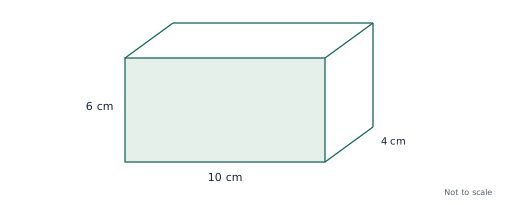
This 10 × 4 × 6 prism has 10 by 4 rectangular sections for internal cuts parallel to its horizontal base. Tilting the plane changes that conclusion. Illustration not to scale.
Work through an example
Use the labelled model to explain: state the cutting direction.
- A cross-section is the flat shape formed where a plane cuts through a solid. A right prism has constant sections when the cutting planes are parallel to its two matching bases.
- This 10 × 4 × 6 prism has 10 by 4 rectangular sections for internal cuts parallel to its horizontal base. Tilting the plane changes that conclusion. Illustration not to scale.
Answer: This 10 × 4 × 6 prism has 10 by 4 rectangular sections for internal cuts parallel to its horizontal base. Tilting the plane changes that conclusion. Illustration not to scale.
Teach in small steps
- Check the starting skill together: Identify the two matching bases of a prism. If this is uncertain, use the objects or drawings before beginning the worksheet.
- Build a rectangular prism from identical layers of cubes. Remove one layer at a time and compare the exposed rectangles.
- Sketch a cutting plane parallel to the base, then a tilted one. Ask which conclusion is justified by the constant-section property.
- Let your child attempt this fresh example: A right square prism has base side 5 cm. Give the shape and area of an internal slice parallel to its base. Ask them to show the representation before checking the solution. Then use the application and checkpoint pages on later sessions.
Ask and listen
- A right octagonal prism is sliced parallel to its bases. How many sides has the section?
- What part of the model helps you check your answer?
Adapt the practice
More support
Use the model to explain each named feature before introducing a fresh question. Keep the scale, units and conditions visible.
More challenge
Ask your child to change one condition and decide whether the original conclusion still follows. Require a labelled example or counterexample.
Look for understanding
- Your child can describe a plane as parallel to a chosen face.
- Your child can explain this point and use it in a fresh problem: “Every slice matches the base” is too broad; the parallel-to-base condition is essential.
Choose the next step
When your child can explain the model and complete fresh practice with little help, use the application problems. If the checkpoint reveals uncertainty, return to this starting skill: Identify the two matching bases of a prism.
Put the idea into practice
The matching topic collection includes learn-and-practise, application and checkpoint PDFs with worked answers. Download the free preview to see representative pages.
Explore this topic’s worksheets