Check the starting point
- Identify radius and diameter
- Distinguish length units from area units
Show the idea
Boundary and surface
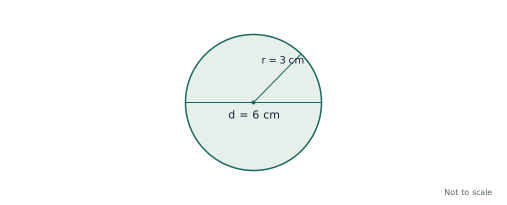
For radius 3 cm, the boundary is C = 6π cm and the enclosed surface is A = 9π cm². The formulas answer different measurement questions.
Work through an example
Boundary and surface — explain the representation.
- For radius 3 cm, the boundary is C = 6π cm and the enclosed surface is A = 9π cm². The formulas answer different measurement questions.
- Connect the labels to the calculation or rule. Diameter must be halved before substitution into a radius-based formula.
Answer: For radius 3 cm, the boundary is C = 6π cm and the enclosed surface is A = 9π cm². The formulas answer different measurement questions.
Teach in small steps
- Begin with a short oral check: ask your child to identify radius and diameter. Then check that they can distinguish length units from area units. Revisit either skill before adding a new procedure.
- Explore “Boundary and surface” together. For radius 3 cm, the boundary is C = 6π cm and the enclosed surface is A = 9π cm². The formulas answer different measurement questions. Ask your child to point to the quantities or features used at each step.
- Model the example: Find area and circumference for radius 4 cm. Pause before each step and invite a prediction. A=π×
 =16π cm². C=2π×4=8π cm.
- Work together on the first new practice question: A circle has diameter 14 cm. Find its exact area and circumference. Have your child attempt the remaining learn questions with less help, then move to apply. Use the checkpoint on a later attempt to see which ideas are retained.
Ask and listen
- A semicircle has radius 4 m. Find its exact area.
- A circle radius triples. Compare the factors by which area and circumference increase.
Adapt the practice
More support
Return to “Boundary and surface” and explain one label or step at a time. Diameter must be halved before substitution into a radius-based formula. Let your child show a calculation, drawing or spoken explanation before requiring a polished written answer.
More challenge
Try this application after the core method is secure: A semicircular window has diameter 12 cm. Find its perimeter, including the straight edge. Then ask which assumption or input could be changed and what would need to be recalculated.
Look for understanding
- The learner can complete and explain this checkpoint task: Find the radius of a circle whose area is 121π cm².
- The learner can address the reasoning or error-checking question: A circle radius triples. Compare the factors by which area and circumference increase. Accept a correct alternative method, but ask for the mathematical reason.
Choose the next step
If both checks can be explained without prompting, continue to Time, duration and time zones. If a method is still uncertain, repeat the visual example with fresh numbers before progressing.
Put the idea into practice
The matching topic collection includes learn-and-practise, application and checkpoint PDFs with worked answers. Download the free preview to see representative pages.
Explore this topic’s worksheets