Check the starting point
- Evaluate basic definite integrals.
- Distinguish density height from probability.
Show the idea
Probability is area under a density
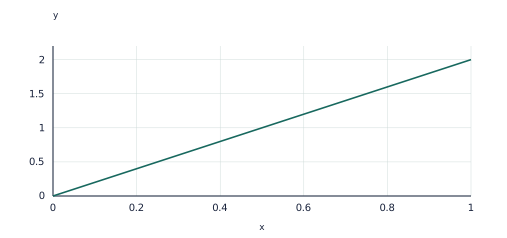
f(x)=2x on [0,1], zero elsewhere, has total triangular area 1. P(X≤ )=
 is an area, not the height f()=1.
Work through an example
f(x)=kx on 0≤x≤2, zero otherwise. Find k.
- A density must have total area 1. Here
 kx dx=1, with no probability density outside [0,2].
- Factor out the constant k and integrate: k
 =k(
 -0)=2k.
- Solve 2k=1 to obtain k=. This is non-negative, so f(x)=
 ≥0 on the specified interval.
- Check: dx=
 =1.
Answer: .
Teach in small steps
- Read the visual model together: f(x)=2x on [0,1], zero elsewhere, has total triangular area 1. P(X≤)= is an area, not the height f()=1.
- Model this example aloud: For f(x)=kx2 on [0,1], zero elsewhere, find k. Guide: The total integral is
 and must equal 1. Hence k=3. Result: 3.
- Let your learner choose the steps for a new situation: X is uniform on [1,7]. Find P(2≤X≤5), E(X), and Var(X). Ask which part of the model or rule carries over before checking the worked solution.
- After a short break, ask for an independent response: For f(x)=2(1−x) on [0,1], find E(X). Compare both the method and conclusion with the checkpoint answers, then revisit any misconception.
Ask and listen
- For f(x)=3
 on [0,1], find P(X≤).
- A density is constant 4 on [0,0.25] and zero elsewhere. Is it valid? Find P(X=0.1).
Adapt the practice
More support
Start with this prerequisite: Evaluate basic definite integrals. Keep the visual visible. For the first guided problem, focus on this step: The total integral is and must equal 1. Hence k=3.
More challenge
Try this application without looking at its answer: For f(x)=3 on [0,1], find the median. Then explain why the answer fits the stated domain or context.
Look for understanding
- Your learner can complete this checkpoint and explain the method: For f(x)=2(1−x) on [0,1], find E(X).
- Your learner can justify or challenge this statement/question using the mathematical definitions: A density is constant 4 on [0,0.25] and zero elsewhere. Is it valid? Find P(X=0.1).
Choose the next step
If either checkpoint needs prompting, repeat the worked model with changed values and revisit this caution: A probability density height is not itself a probability. When both are secure, use the linked Apply and extend resource and relevant VCE Key Knowledge/Key Skills activity.
Put the idea into practice
The matching topic collection includes learn-and-practise, application and checkpoint PDFs with worked answers. Download the free preview to see representative pages.
Explore this topic’s worksheets