Check the starting point
- Recognise side and angle properties
- Test whether three positive lengths form a triangle
Show the idea
A shape can belong to several classes
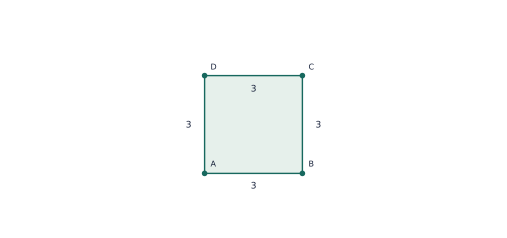
This 3-by-3 square has four equal sides and four right angles. It is also a rectangle, rhombus and parallelogram.
Work through an example
A shape can belong to several classes — explain the representation.
- This 3-by-3 square has four equal sides and four right angles. It is also a rectangle, rhombus and parallelogram.
- Connect the labels to the calculation or rule. A square is a special rectangle; shape classes can overlap.
Answer: This 3-by-3 square has four equal sides and four right angles. It is also a rectangle, rhombus and parallelogram.
Teach in small steps
- Begin with a short oral check: ask your child to recognise side and angle properties. Then check that they can test whether three positive lengths form a triangle. Revisit either skill before adding a new procedure.
- Explore “A shape can belong to several classes” together. This 3-by-3 square has four equal sides and four right angles. It is also a rectangle, rhombus and parallelogram. Ask your child to point to the quantities or features used at each step.
- Model the example: Classify a quadrilateral with four equal sides and four right angles. Pause before each step and invite a prediction. Four right angles make it a rectangle. Four equal sides make it a rhombus.
- Work together on the first new practice question: Classify a valid triangle with sides 9 cm, 9 cm and 9 cm by side lengths. Have your child attempt the remaining learn questions with less help, then move to apply. Use the checkpoint on a later attempt to see which ideas are retained.
Ask and listen
- Could lengths 2 cm, 3 cm and 5 cm form a triangle? Explain before assigning a triangle class.
- An algorithm classifies a rotated square as a diamond and not a square. What property-based test would repair it?
Adapt the practice
More support
Return to “A shape can belong to several classes” and explain one label or step at a time. A square is a special rectangle; shape classes can overlap. Let your child show a calculation, drawing or spoken explanation before requiring a polished written answer.
More challenge
Try this application after the core method is secure: Using the stated inclusive trapezium definition, explain how a non-square rectangle can also be a trapezium. Then ask which assumption or input could be changed and what would need to be recalculated.
Look for understanding
- The learner can complete and explain this checkpoint task: A triangle has angles 50°, 50° and 80°. Classify it by sides and by angles.
- The learner can address the reasoning or error-checking question: An algorithm classifies a rotated square as a diamond and not a square. What property-based test would repair it? Accept a correct alternative method, but ask for the mathematical reason.
Choose the next step
If both checks can be explained without prompting, continue to Coordinate transformations. If a method is still uncertain, repeat the visual example with fresh numbers before progressing.
Put the idea into practice
The matching topic collection includes learn-and-practise, application and checkpoint PDFs with worked answers. Download the free preview to see representative pages.
Explore this topic’s worksheets