Check the starting point
- Use Pythagoras in a right triangle.
- Distinguish linear, area and volume units.
Show the idea
A right triangle links lengths and angles
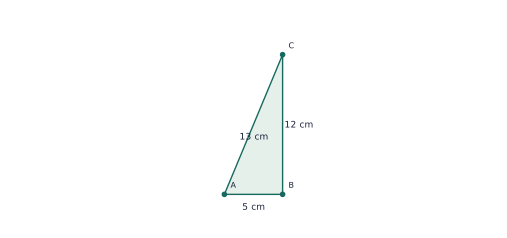
AB and BC are perpendicular. Pythagoras gives AC= =13 cm. Use the side opposite the chosen angle when selecting a ratio.
Work through an example
A right triangle has legs 5 cm and 12 cm. Find hypotenuse.
- The hypotenuse is opposite the right angle. Apply Pythagoras' theorem to the two legs:
 =
 +
 .
- Calculate the squares first: =25+144=169.
- As a length is positive, c=
 =13 cm. Check:
 =169.
Answer: 13 cm.
Teach in small steps
- Read the visual model together: AB and BC are perpendicular. Pythagoras gives AC==13 cm. Use the side opposite the chosen angle when selecting a ratio.
- Model this example aloud: A right triangle has hypotenuse 17 cm and one leg 8 cm. Find the other leg. Guide: The missing squared leg is
 −
 =225. Select the positive square root. Result: 15 cm.
- Let your learner choose the steps for a new situation: Two sides of a triangle are 5 m and 8 m with included angle 60°. Find the third side. Ask which part of the model or rule carries over before checking the worked solution.
- After a short break, ask for an independent response: A sector has radius 5 cm and angle 72°. Find arc length and area. Compare both the method and conclusion with the checkpoint answers, then revisit any misconception.
Ask and listen
- Convert 0.75
 to cm2 and 2.4 litres to cm3.
- A 10 m ladder reaches 8 m up a vertical wall. Find its distance from the wall and angle above level ground.
Adapt the practice
More support
Start with this prerequisite: Use Pythagoras in a right triangle. Keep the visual visible. For the first guided problem, focus on this step: The missing squared leg is −=225. Select the positive square root.
More challenge
Try this application without looking at its answer: Similar containers have length ratio 3:2. If the smaller volume is 80 cm3, find the larger volume. Then explain why the answer fits the stated domain or context.
Look for understanding
- Your learner can complete this checkpoint and explain the method: A sector has radius 5 cm and angle 72°. Find arc length and area.
- Your learner can justify or challenge this statement/question using the mathematical definitions: A 10 m ladder reaches 8 m up a vertical wall. Find its distance from the wall and angle above level ground.
Choose the next step
If either checkpoint needs prompting, repeat the worked model with changed values and revisit this caution: Similar solids scale area by  and volume by
 . When both are secure, use the linked Apply and extend resource and relevant VCE Key Knowledge/Key Skills activity.
Put the idea into practice
The matching topic collection includes learn-and-practise, application and checkpoint PDFs with worked answers. Download the free preview to see representative pages.
Explore this topic’s worksheets