Check the starting point
- Recognise the faces and edges of a solid
- Match equal edges in a proposed net
Show the idea
Six connected squares make this cube net
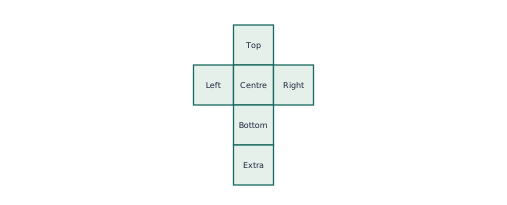
Fold Top, Left, Right and Bottom around Centre. Extra folds over to close the cube opposite Centre. Each face is one equal square.
Work through an example
Which face in this net will be opposite Centre after folding?
- Keep Centre flat and fold its four neighbouring squares up to form the sides.
- Extra is joined to Bottom and folds over the opening above Centre.
Answer: Extra is opposite Centre.
Teach in small steps
- Check the starting skill together: Recognise the faces and edges of a solid. If this is uncertain, use the objects or drawings before beginning the worksheet.
- Draw the six-square arrangement on squared paper. Label the named faces and predict opposite pairs before folding.
- Cut and fold the net, with adult help when needed. Compare the physical result with the original prediction and explain any overlap.
- Let your child attempt this fresh example: How many square faces must a cube net contain? Ask them to show the representation before checking the solution. Then use the application and checkpoint pages on later sessions.
Ask and listen
- A rectangular prism is 5 cm × 3 cm × 2 cm. List the three face-size pairs.
- What part of the model helps you check your answer?
Adapt the practice
More support
Use the model to explain each named feature before introducing a fresh question. Keep the scale, units and conditions visible.
More challenge
Ask your child to change one condition and decide whether the original conclusion still follows. Require a labelled example or counterexample.
Look for understanding
- Your child can match equal edges in a proposed net.
- Your child can explain this point and use it in a fresh problem: Correct face counts alone do not prove a drawing will fold into the required solid.
Choose the next step
When your child can explain the model and complete fresh practice with little help, use the application problems. If the checkpoint reveals uncertainty, return to this starting skill: Recognise the faces and edges of a solid.
Put the idea into practice
The matching topic collection includes learn-and-practise, application and checkpoint PDFs with worked answers. Download the free preview to see representative pages.
Explore this topic’s worksheets