Check the starting point
- Measure a perpendicular height
- Calculate rectangle area
Show the idea
A right triangle fills half a rectangle
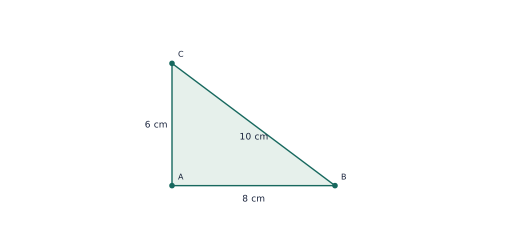
A triangle with perpendicular legs 8 cm and 6 cm has area 8 × 6 ÷ 2 = 24 cm². The vertical leg is the perpendicular height.
Work through an example
A right triangle fills half a rectangle — explain the representation.
- A triangle with perpendicular legs 8 cm and 6 cm has area 8 × 6 ÷ 2 = 24 cm². The vertical leg is the perpendicular height.
- Connect the labels to the calculation or rule. Use perpendicular height, not an arbitrary sloping side.
Answer: A triangle with perpendicular legs 8 cm and 6 cm has area 8 × 6 ÷ 2 = 24 cm². The vertical leg is the perpendicular height.
Teach in small steps
- Begin with a short oral check: ask your child to measure a perpendicular height. Then check that they can calculate rectangle area. Revisit either skill before adding a new procedure.
- Explore “A right triangle fills half a rectangle” together. A triangle with perpendicular legs 8 cm and 6 cm has area 8 × 6 ÷ 2 = 24 cm². The vertical leg is the perpendicular height. Ask your child to point to the quantities or features used at each step.
- Model the example: A triangle has base 14 cm and perpendicular height 9 cm. Find its area. Pause before each step and invite a prediction. A=
 . 14 ×
 =63.
- Work together on the first new practice question: Find the area of a triangle with base 18 cm and perpendicular height 5 cm. Have your child attempt the remaining learn questions with less help, then move to apply. Use the checkpoint on a later attempt to see which ideas are retained.
Ask and listen
- A parallelogram has base 13 m and perpendicular height 4 m. Find its area.
- A parallelogram has base 10 cm, sloping side 7 cm and perpendicular height 5 cm. A learner gives area 70 cm². Correct the answer.
Adapt the practice
More support
Return to “A right triangle fills half a rectangle” and explain one label or step at a time. Use perpendicular height, not an arbitrary sloping side. Let your child show a calculation, drawing or spoken explanation before requiring a polished written answer.
More challenge
Try this application after the core method is secure: A rectangular floor is 9 m by 6 m. A non-overlapping triangular extension has base 6 m and height 4 m. Find their combined area. Then ask which assumption or input could be changed and what would need to be recalculated.
Look for understanding
- The learner can complete and explain this checkpoint task: A triangle has base 12 cm and area 42 cm². Find its height.
- The learner can address the reasoning or error-checking question: A parallelogram has base 10 cm, sloping side 7 cm and perpendicular height 5 cm. A learner gives area 70 cm². Correct the answer. Accept a correct alternative method, but ask for the mathematical reason.
Choose the next step
If both checks can be explained without prompting, continue to Volume of right prisms. If a method is still uncertain, repeat the visual example with fresh numbers before progressing.
Put the idea into practice
The matching topic collection includes learn-and-practise, application and checkpoint PDFs with worked answers. Download the free preview to see representative pages.
Explore this topic’s worksheets