Check the starting point
- Complete a square and read Cartesian coordinates.
- Use x=r cos θ and y=r sin θ.
Show the idea
The two semi-axes of an ellipse
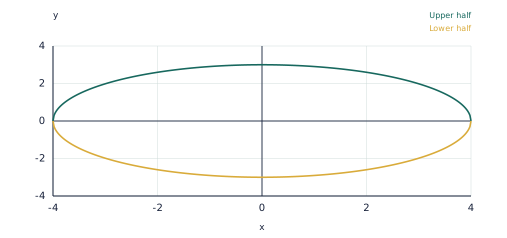
The ellipse  +
 =1 has horizontal semi-axis 4 and vertical semi-axis 3. Its four intercepts are (±4,0) and (0,±3).
Work through an example
Eliminate t from x=2 cos t, y=3 sin t.
- From x=2 cos t and y=3 sin t, isolate cos t=
 and sin t=
 .
- Square both relations and add:
 +
 =cos2 t+sin2 t=1.
- The Cartesian relation is an ellipse centred at the origin, with horizontal semiaxis 2 and vertical semiaxis 3. The parameter interval, if restricted, determines which part is traced.
Answer: +=1.
Teach in small steps
- Read the visual model together: The ellipse +=1 has horizontal semi-axis 4 and vertical semi-axis 3. Its four intercepts are (±4,0) and (0,±3).
- Model this example aloud: Find the centre and radius of
 +
 −6x+4y−12=0. Guide: Complete squares to get
 +
 =25. Result: Centre (3,−2); radius 5.
- Let your learner choose the steps for a new situation: Eliminate t from x=3cos t, y=5sin t, 0≤t<2π. Ask which part of the model or rule carries over before checking the worked solution.
- After a short break, ask for an independent response: Find the asymptotes of
 −=1. Compare both the method and conclusion with the checkpoint answers, then revisit any misconception.
Ask and listen
- For =12x, find focus and directrix.
- Eliminate t from x=t−2, y=
 for t≤0, retaining the restriction.
Adapt the practice
More support
Start with this prerequisite: Complete a square and read Cartesian coordinates. Keep the visual visible. For the first guided problem, focus on this step: Complete squares to get +=25.
More challenge
Try this application without looking at its answer: Convert r=6sin θ to Cartesian form. Then explain why the answer fits the stated domain or context.
Look for understanding
- Your learner can complete this checkpoint and explain the method: Find the asymptotes of −=1.
- Your learner can justify or challenge this statement/question using the mathematical definitions: Eliminate t from x=t−2, y= for t≤0, retaining the restriction.
Choose the next step
If either checkpoint needs prompting, repeat the worked model with changed values and revisit this caution: Eliminating a parameter must retain any restrictions on the traced portion. When both are secure, use the linked Apply and extend resource and relevant VCE Key Knowledge/Key Skills activity.
Put the idea into practice
The matching topic collection includes learn-and-practise, application and checkpoint PDFs with worked answers. Download the free preview to see representative pages.
Explore this topic’s worksheets