Check the starting point
- Partition numbers into convenient place-value parts
- Use subtraction to check an addition
Show the idea
Keep the whole and its parts connected
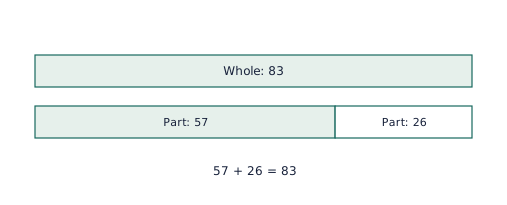
The two parts 57 and 26 combine to make 83. The lower bars together match the full length of the whole.
Work through an example
The whole is 83 and one part is 57. Find the missing part.
- Subtract the known part from the whole: 83 - 57 = 26.
- Check by joining both parts: 57 + 26 = 83.
Answer: 26
Teach in small steps
- Check the starting skill together: Partition numbers into convenient place-value parts. If this is uncertain, use the objects or drawings before beginning the worksheet.
- Build 57 and 26 as separate quantities, join them and record the total 83.
- Cover one part of the drawing. Ask which inverse calculation recovers it, then compare counting-on and subtraction methods.
- Let your child attempt this fresh example: Calculate 57 + 26 using a make-ten or partitioning method. Ask them to show the representation before checking the solution. Then use the application and checkpoint pages on later sessions.
Ask and listen
- Find the difference between 89 and 57.
- What part of the model helps you check your answer?
Adapt the practice
More support
Keep the labelled model beside the problem. Let your child describe each step aloud before writing the calculation.
More challenge
Change one quantity in the example, predict what changes, and check the prediction with a second representation.
Look for understanding
- Your child can use subtraction to check an addition.
- Your child can explain this point and use it in a fresh problem: The equal sign means both sides have the same value; it does not simply mean “write the answer next”.
Choose the next step
When your child can explain the model and complete fresh practice with little help, use the application problems. If the checkpoint reveals uncertainty, return to this starting skill: Partition numbers into convenient place-value parts.
Put the idea into practice
The matching topic collection includes learn-and-practise, application and checkpoint PDFs with worked answers. Download the free preview to see representative pages.
Explore this topic’s worksheets