Check the starting point
- Locate curve intersections and axis crossings.
- Distinguish a signed rate from a total amount.
Show the idea
Area uses the difference between curves
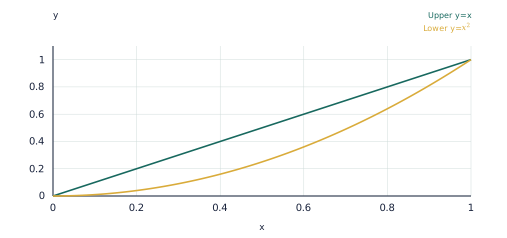
On [0,1], y=x lies above y= . Their area is
 (x−) dx=
 ; the two curves meet at both endpoints.
Work through an example
Find area between y=x and y= on [0, 1].
- The curves meet where x=, so x(x-1)=0 and the intersection points have x=0 and x=1.
- On 0≤x≤1, x≥, so area is the integral of upper minus lower:
 (x-) dx.
- An antiderivative is
 -
 . Evaluate at 1 and subtract its value at 0: (
 -
 )-0=.
- The answer is positive and represents area in square units.
Answer: .
Teach in small steps
- Read the visual model together: On [0,1], y=x lies above y=. Their area is (x−) dx=; the two curves meet at both endpoints.
- Model this example aloud: Find the area under y=3x+2 on [0,2]. Guide: The curve is non-negative. Evaluate (
 )+2x between 0 and 2. Result: 10 square units.
- Let your learner choose the steps for a new situation: A tank starts with 12 L and has net inflow r(t)=2t+1 L/min for 0≤t≤4. Find the final volume. Ask which part of the model or rule carries over before checking the worked solution.
- After a short break, ask for an independent response: For v(t)=2t−2 on 0≤t≤3, find displacement and distance travelled. Compare both the method and conclusion with the checkpoint answers, then revisit any misconception.
Ask and listen
- Find the average value of +1 on [0,3].
- If a rate is measured in dollars per week and time in weeks, what units does its definite integral have?
Adapt the practice
More support
Start with this prerequisite: Locate curve intersections and axis crossings. Keep the visual visible. For the first guided problem, focus on this step: The curve is non-negative. Evaluate ()+2x between 0 and 2.
More challenge
Try this application without looking at its answer: Find the geometric area between y= and y=4 on −2≤x≤2. Then explain why the answer fits the stated domain or context.
Look for understanding
- Your learner can complete this checkpoint and explain the method: For v(t)=2t−2 on 0≤t≤3, find displacement and distance travelled.
- Your learner can justify or challenge this statement/question using the mathematical definitions: If a rate is measured in dollars per week and time in weeks, what units does its definite integral have?
Choose the next step
If either checkpoint needs prompting, repeat the worked model with changed values and revisit this caution: Geometric area requires nonnegative contributions, while signed integrals can cancel. When both are secure, use the linked Apply and extend resource and relevant VCE Key Knowledge/Key Skills activity.
Put the idea into practice
The matching topic collection includes learn-and-practise, application and checkpoint PDFs with worked answers. Download the free preview to see representative pages.
Explore this topic’s worksheets