Check the starting point
- Evaluate function notation at a given input.
- Solve linear equations and simple square-root inequalities.
Show the idea
Domain and range belong to the rule
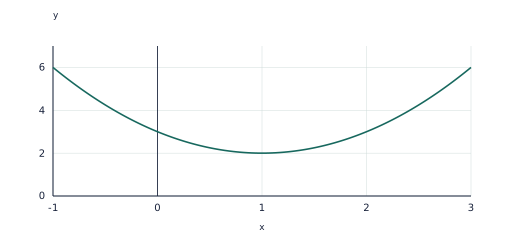
On −1≤x≤3, f(x)= +2 has range [2,6]. The repeated outputs on either side of x=1 prevent an inverse function on the whole interval.
Work through an example
Let f(x)=3 x −5 for all real x. Find  .
- Write y=3x-5. Add 5 to obtain y+5=3x, then divide by 3: x=
 .
- Interchange the variable names to express the inverse as =
 .
- The original linear function has non-zero slope and domain all real numbers, so it is one-to-one with range all real numbers. The inverse also has domain all real numbers.
- Check by composition: f()=3()-5=x.
Answer: .
Teach in small steps
- Read the visual model together: On −1≤x≤3, f(x)=+2 has range [2,6]. The repeated outputs on either side of x=1 prevent an inverse function on the whole interval.
- Model this example aloud: Find the maximal real domain and range of f(x)=
 −1. Guide: Require x+5≥0. The square root is non-negative and reaches 0 at x=−5, giving minimum output −1. Result: Domain [−5,∞); range [−1,∞).
- Let your learner choose the steps for a new situation: A conversion model is C(m)=12+3m for m≥0. Find the inverse rule and its domain. Ask which part of the model or rule carries over before checking the worked solution.
- After a short break, ask for an independent response: Find the range of f(x)=2−
 for −3≤x≤1. Compare both the method and conclusion with the checkpoint answers, then revisit any misconception.
Ask and listen
- Find the inverse of f(x)=4x−7, defined for all real x.
- A mapping sends 1→4, 2→6 and 3→4. Is it a function, and can it have an inverse function on all three inputs?
Adapt the practice
More support
Start with this prerequisite: Evaluate function notation at a given input. Keep the visual visible. For the first guided problem, focus on this step: Require x+5≥0. The square root is non-negative and reaches 0 at x=−5, giving minimum output −1.
More challenge
Try this application without looking at its answer: Find the inverse of f(x)= +3 with x≥−1. Then explain why the answer fits the stated domain or context.
Look for understanding
- Your learner can complete this checkpoint and explain the method: Find the range of f(x)=2− for −3≤x≤1.
- Your learner can justify or challenge this statement/question using the mathematical definitions: A mapping sends 1→4, 2→6 and 3→4. Is it a function, and can it have an inverse function on all three inputs?
Choose the next step
If either checkpoint needs prompting, repeat the worked model with changed values and revisit this caution: A function gives each input one output; an inverse is a function only when the original mapping is one-to-one on its domain. When both are secure, use the linked Apply and extend resource and relevant VCE Key Knowledge/Key Skills activity.
Put the idea into practice
The matching topic collection includes learn-and-practise, application and checkpoint PDFs with worked answers. Download the free preview to see representative pages.
Explore this topic’s worksheets