Check the starting point
- Identify the same-sized whole before comparing fractions
- Explain what the numerator and denominator count
Show the idea
Rename before combining
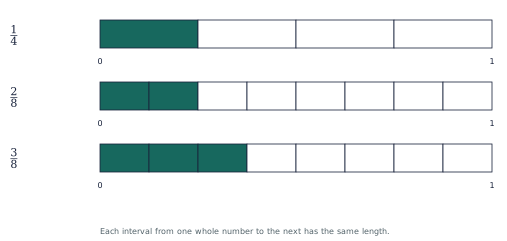
Each row represents the same whole. The first two rows show equivalent forms of the first fraction; the third shows the second fraction in the same-sized parts.
Work through an example
Name each shaded fraction, then add the first and third shaded amounts.
- The first strip has 4 equal parts and 1 shaded, so it shows
 .
- Splitting each of those parts into smaller equal parts gives
 ; the shaded length has not changed.
- The third strip shows
 . All strips represent the same-sized whole, so the fractions can be compared or combined.
- Use 8 as the common denominator so that the parts have the same size. = ; already uses eighths. + =
 .
Add the numerators and keep the common denominator; simplify by dividing both parts by the same non-zero factor.
Answer: ; ; . Sum: .
Teach in small steps
- Check the starting skill together: Identify the same-sized whole before comparing fractions. If this is uncertain, use the objects or drawings before beginning the worksheet.
- Cut equal-length paper strips and partition them into the denominators shown in the model. Keep their endpoints aligned.
- Shade the stated numerators and explain how regrouping equal parts changes the fraction name without changing the shaded amount.
- Let your child attempt this fresh example: Calculate + . Show equivalent fractions. Ask them to show the representation before checking the solution. Then use the application and checkpoint pages on later sessions.
Ask and listen
- Find the difference between and .
- What part of the model helps you check your answer?
Adapt the practice
More support
Begin with halves and quarters made by folding identical paper strips. Do not compare fractions of differently sized wholes until the whole is explicitly discussed.
More challenge
Use a number line to place equivalent fractions at the same point, then explain the connection to the shaded strip.
Look for understanding
- Your child can explain what the numerator and denominator count.
- Your child can explain this point and use it in a fresh problem: Do not add denominators when adding fractions; first express the quantities using the same-sized parts.
Choose the next step
When your child can explain the model and complete fresh practice with little help, use the application problems. If the checkpoint reveals uncertainty, return to this starting skill: Identify the same-sized whole before comparing fractions.
Put the idea into practice
The matching topic collection includes learn-and-practise, application and checkpoint PDFs with worked answers. Download the free preview to see representative pages.
Explore this topic’s worksheets